Quiet Your Home Naturally with Sound-Reducing Shades & Shutters
Silence has a texture. Sometimes it feels soft and calming, other times it’s the absence you crave after a long day of constant noise. In busy neighborhoods, near highways, or in homes filled with activity, quiet can feel out of reach.
Sound travels through gaps, glass, and hard surfaces, turning everyday noise into an exhausting background hum. While walls and insulation help, windows are often the weakest barrier when it comes to noise control.
Thoughtfully chosen shades and shutters can significantly reduce unwanted sound while improving comfort and functionality. When designed correctly, they transform windows from noise entry points into effective sound buffers.
How Sound Enters Through Windows
Noise doesn’t simply pass straight through glass; it vibrates surfaces and slips through tiny openings. According to acoustical studies, up to 70% of exterior noise can enter a room through windows in urban environments.
Single-pane glass is especially vulnerable because it lacks mass and air space. Even modern double-pane windows still allow mid- and high-frequency sounds to travel through.
Key sound entry factors include:
- Thin glass that vibrates easily
- Air gaps around window frames
- Hard surfaces that reflect sound inward
This is why adding an interior layer, such as the right window covering, can make a noticeable difference.
Understanding Sound Absorption vs. Sound Blocking
Not all window treatments reduce noise in the same way. Some absorb sound waves, while others block them by adding mass and sealing gaps.
Sound absorption reduces echo and interior noise levels. Sound blocking prevents exterior noise from entering. The most effective solutions often do both.
The National Institute of Building Sciences notes that increasing material density and adding air pockets can improve sound reduction by 3–10 decibels, which the human ear perceives as a meaningful drop in volume.
Cellular Shades and Their Acoustic Advantage
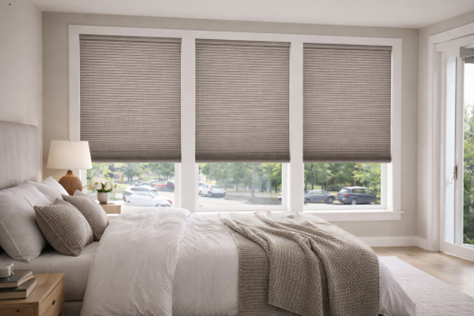
Cellular shades, also known as honeycomb shades, are designed with internal air pockets that trap sound. These pockets disrupt sound waves before they enter the room.
Double-cell designs outperform single-cell options. Independent testing shows cellular shades can reduce noise by up to 45%, depending on fabric weight and cell depth.
Their structure also improves thermal insulation, which explains why homeowners often report quieter rooms during temperature extremes when HVAC systems run less frequently.
Roller Shades with Acoustic Fabrics
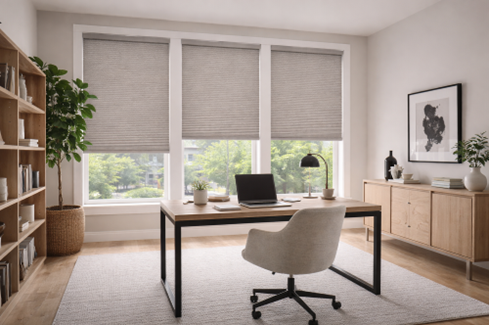
Roller shades are often associated with minimalism, but when paired with dense or acoustically rated fabrics, they become effective noise reducers.
Heavier fabrics absorb mid-range frequencies, such as traffic and voices. When installed close to the window frame, they reduce sound leakage around edges.
Benefits of acoustic roller shades include:
- Smooth, modern appearance
- Consistent coverage across large windows
- Reduced reverberation in open spaces
In lofts and home offices, these shades can lower perceived noise levels enough to improve focus and sleep quality.
Plantation Shutters as Sound Barriers
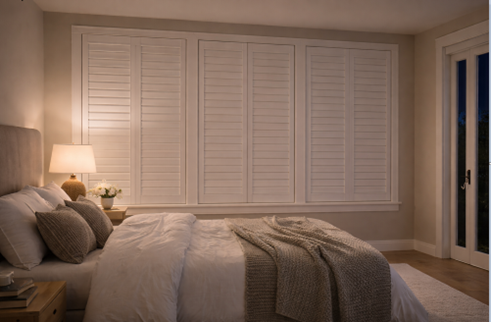
Shutters add mass, which is critical for blocking sound. Solid composite or wood shutters are especially effective because of their thickness and tight fit.
When closed, shutters create an additional barrier that reduces vibration. Studies in residential acoustics show that layered barriers can reduce sound transmission by 6–12 decibels.
Full-height shutters also limit sound leaks better than partial coverings. Their rigid panels absorb less sound than fabric but block more external noise when sealed properly.
The Role of Proper Fit and Installation
Even the best materials fail if gaps remain. Sound finds the smallest openings, which is why precision matters.
A properly fitted shade or shutter minimizes:
- Side light gaps that carry sound
- Top openings where noise funnels inward
- Loose mounting that allows vibration
According to building performance data, sealing gaps can improve noise reduction by up to 20% compared to loosely fitted coverings.
Layering Window Treatments for Maximum Quiet
Combining window treatments increases effectiveness. Layering creates multiple barriers, each reducing sound energy before it reaches the room.
A common approach pairs:
- Cellular shades for absorption
- Shutters or drapery panels for blocking
This layered strategy mimics professional soundproofing techniques used in studios, scaled for residential comfort.
Secondary Benefits Beyond Noise Control
Quieter rooms often feel more comfortable overall. Reduced noise improves sleep quality, lowers stress levels, and supports productivity.
The World Health Organization reports that prolonged exposure to noise above 55 decibels increases stress hormones and disrupts rest. Even modest reductions can improve daily well-being.
Additional benefits include:
- Improved energy efficiency
- Enhanced privacy
- Reduced glare and light intrusion
Choosing the Right Solution for Your Space
Different rooms have different sound challenges. Bedrooms benefit from absorption and full coverage, while living areas often need a balance of noise reduction and light control.
High-traffic locations may prioritize blocking exterior noise. Interior rooms benefit more from echo reduction and sound softening.
Evaluating window size, orientation, and nearby noise sources ensures the solution performs as expected.
A Quieter Home Starts at the Window
Reducing noise doesn’t require structural changes or major renovations. Strategic window treatments can significantly soften the sounds that disrupt daily life.
Shades and shutters work quietly in the background, improving comfort without changing how a home feels or functions.
When sound becomes manageable, spaces feel calmer, more personal, and easier to enjoy. How would your daily routine change if your home sounded as peaceful as it looks?
Some blogs are written by authorized members of our marketing team for marketing purposes only. Some content may not correctly depict product specifications and may vary depending on the product. For more information, please call our sales office. Top of Form